Tuesday Night, Thunder Quads: What Britain's Roller Derby Revival Can Teach the Gym Floor
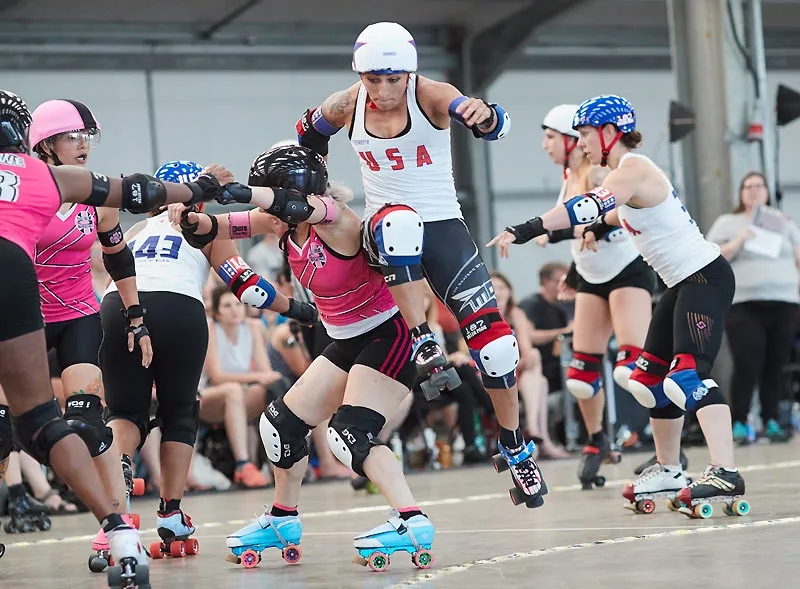
Photo: roller derby skaters women quad skates track, via i.pinimg.com
The sports hall in Salford smells of grip tape and determination. Twenty-odd skaters are crouched low, hip to hip, thighs burning through a drill that looks simple and absolutely is not: hold the derby stance, knees bent, weight back, while a teammate tries to shove you off your line. Nobody is complaining. Everybody's quads are on fire. This is Tuesday night at a roller derby league, and it might be the hardest leg session in British amateur sport.
The Comeback Nobody Saw Coming
Roller derby — flat-track, full-contact, played on quad skates — has been quietly rebuilding across the UK. Leagues in Manchester, Glasgow, Bristol, Leeds and London are recruiting again after a lean few years, and the intake is striking: overwhelmingly women and non-binary skaters, in a sport that was built by women, for women, run by the people who play it.
There's no federation telling them what to do. There's a dues-paying, committee-rotating, do-it-yourself ethos that runs from the kit to the coaching. And there's a body-positive culture that genuinely means it — skaters of every shape and size, because in derby, every build has a tactical advantage. Low centre of gravity? You're a wall. Long legs? You're a jammer's nightmare.
The Derby Stance: An Isometric Nightmare
Everything in derby starts with the stance: knees deeply bent, thighs nearly parallel to the floor, weight on the back wheels. Skaters hold this position — through drills, through jams, through eight-minute blocks of sustained effort.
"The first six weeks, you can't walk down stairs properly," says Faye, three seasons in with her Manchester league. "Your quads just scream. But that's the sport. Your legs ARE the sport."
It's essentially a moving wall sit performed at speed on eight wheels, punctuated by explosive sprints, sudden stops, lateral shoves and hits absorbed through braced, loaded legs. The eccentric work — controlling deceleration while someone the size of a wardrobe pushes into you — is the kind of thing strength coaches prescribe with bands and boxes. Derby skaters get it live, nightly.
Sprint, Block, Repeat
A single two-minute jam can involve repeated maximal sprints from a dead stop — the single most quad-dominant movement pattern there is. Jammers (the point-scorers) are essentially sprinters on skates. Blockers are isometric athletes who also hit people. Every position on track demands the full spectrum of leg strength: power, endurance, stability, reaction.
Off-skates, leagues supplement with squats, lunges and skate-specific conditioning — but the track does the heavy lifting. Or rather, the heavy holding.
Why It Fits This Site Perfectly
Look, we're a leg-focused publication. Roller derby is a leg-focused sport wrapped in a community we'd happily join. It's inclusive without being tokenistic, brutal without being exclusionary, and it proves the point we keep making: the best leg training doesn't always happen in a gym, and it definitely doesn't require a membership card and a mirror.
If your Tuesday currently involves a treadmill and a podcast, consider this: there's a sports hall near you full of people squatting low on eight wheels, laughing through the burn, building the strongest thighs of their lives. Derby girls don't skip leg day. Leg day just looks a bit different when you're wearing a mouthguard.