Float Like a Butterfly, Squat Like a Champion: How Britain's Boxing Revival Is Forging Explosive Legs
Float Like a Butterfly, Squat Like a Champion: How Britain's Boxing Revival Is Forging Explosive Legs
There's a peculiar thing happening in community halls, converted garages, and inner-city gyms from Salford to Swansea. Punching bags are swinging again. Speed balls are rattling. And legs — quietly, relentlessly — are getting absolutely destroyed.
Britain's grassroots boxing scene is in the middle of a proper comeback. After years of decline, local clubs are reporting surging memberships, with everyone from teenagers to retired postal workers lacing up gloves for the first time. Most of them turn up expecting to get their arms in shape. What they don't anticipate is leaving with calves like granite and quads that scream on the stairs the next morning.
The ring, it turns out, is one of the UK's most underrated leg day destinations.
The Footwork Factor
Ask any decent boxing coach what separates a good fighter from a great one, and they'll tell you the same thing: it's not the hands, it's the feet.
"New members always want to talk about punching," says Marcus Webb, head coach at a community boxing club in Leeds that's been running for over thirty years. "I spend the first month just working on how they move. By the end of it, their legs are cooked — and they haven't thrown a single proper combination."
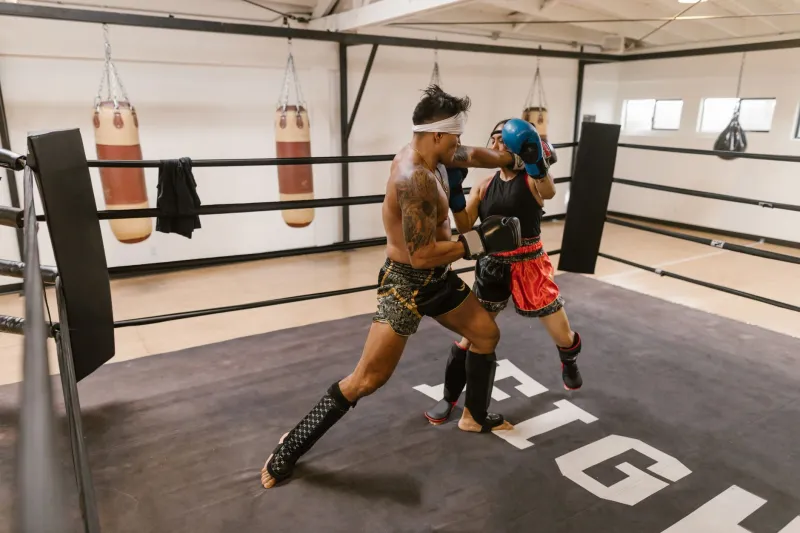
Boxing footwork isn't just shuffling around a ring. It's a continuous series of explosive lateral movements, pivots, weight transfers, and split-second direction changes, all performed in a semi-crouched athletic stance that keeps the hips loaded and the glutes permanently engaged. You're essentially doing a very long, very chaotic lateral lunge series — except nobody calls it that, because it sounds far less cool.
From a biomechanical standpoint, the demands are serious. The constant lowered stance activates the vastus medialis — the teardrop-shaped quad muscle that gives knees their stability — while the pivot and push-off mechanics hammer the peroneals, calves, and hip abductors simultaneously. Studies on combat sports athletes consistently show lower body power outputs that rival those of sprinters and rugby players. Not bad for a sport most people associate with arms.
Skip to the Good Bit
Before any sparring, before any pad work, before a single punch gets thrown, there's skipping. Always skipping.
The humble jump rope is the boxing world's most underappreciated conditioning tool, and from a leg development perspective, it's genuinely remarkable. A typical boxing gym warm-up involves fifteen to twenty minutes of continuous skipping — a low-impact, high-frequency calf raise that also demands significant ankle stability, coordination, and hip flexor endurance.
"I had shin splints when I started," admits Priya Sharma, a 34-year-old nurse from Birmingham who joined her local club eighteen months ago. "My physio was confused because I told her I wasn't running. Then I described what I was doing and she just laughed and said, 'That's why.'"
Shin splints — or more accurately, medial tibial stress syndrome — are the calling card of the tibialis anterior being overloaded, which is precisely what happens when your calves and lower legs are suddenly working harder than they ever have before. It's not an injury to celebrate, but it is evidence of genuine muscular adaptation happening at pace.
Once you're past that initial conditioning phase, the skipping pays dividends. Calf hypertrophy, improved ankle proprioception, and the kind of springy, reactive lower leg strength that makes every other sport feel easier.
The Stance That's Actually a Single-Leg Squat
Here's something boxing coaches know instinctively but rarely articulate in fitness terms: the orthodox boxing stance — weight distributed roughly 60/40 across the back and front foot, knees slightly bent, hips dropped — is a sustained isometric single-leg loading exercise.
For the duration of a three-minute round, your rear leg is holding a partial squat position while your front leg acts as a dynamic stabiliser. Multiply that across six, eight, or ten rounds of pad work, bag work, and sparring, and you've accumulated a staggering volume of unilateral leg work that most structured gym programmes never come close to replicating.
"I've been lifting weights for years," says Dominic Price, a 41-year-old from Manchester who took up boxing during lockdown and never stopped. "Six months in the ring and my single-leg stability improved more than it had in a decade of doing Bulgarian split squats. My physio was genuinely baffled."
Community, Culture, and Calves
What makes Britain's boxing revival particularly interesting isn't just the physical output — it's who's showing up. These aren't elite athletes chasing titles. They're teachers, warehouse workers, students, and grandparents who've found something in the rhythm and discipline of the gym that a treadmill never gave them.
The community boxing club occupies a unique cultural space in British life, particularly in towns where traditional industry has long since departed. In places like Hartlepool, Rotherham, and Merthyr Tydfil, boxing gyms have historically served as anchors — spaces where young people find structure and older members find purpose. The current revival is drawing on that legacy while welcoming people who've never thrown a punch in anger.
And their legs are all the better for it.
Should You Give It a Go?
If your leg training has plateaued, if the squat rack feels stale, or if you simply want to move better and develop the kind of functional lower body strength that translates to real life, a boxing gym is worth serious consideration.
You don't need to spar. You don't need to compete. Most clubs offer fitness-focused sessions that keep you well away from anyone trying to hit you. What you will get is footwork drills that challenge your coordination, skipping that transforms your calves, and bag work that demands more from your legs than your arms ever will.
Britain's boxing clubs are open. The skipping ropes are ready. Your legs won't know what's hit them — but they'll thank you for it eventually.