Built by the Victorians, Felt in Your Quads: Why Britain's Steepest Staircases Are the Best Leg Machines Ever Made
Built by the Victorians, Felt in Your Quads: Why Britain's Steepest Staircases Are the Best Leg Machines Ever Made
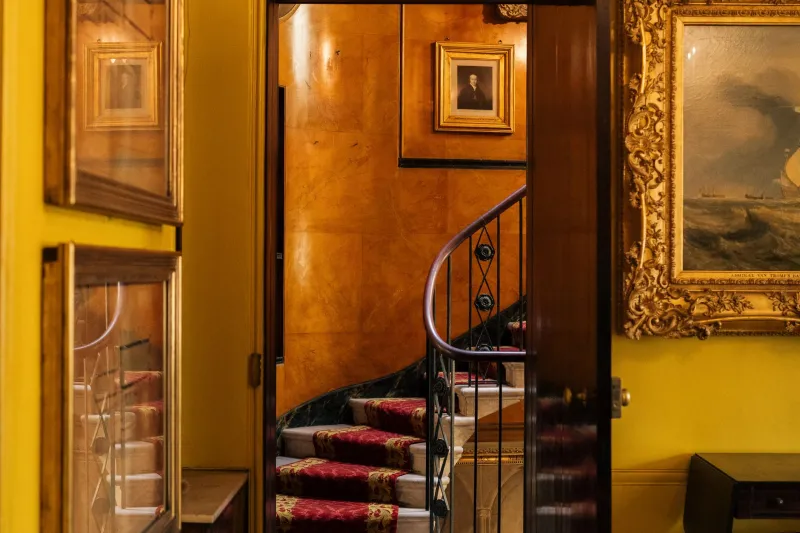
If you've ever visited a friend in a Victorian terrace and nearly needed a rope and a prayer to get to the upstairs loo, you'll know exactly what we're talking about. Those staircases are not messing around. Steep as a cliff face, narrow as a moral argument, with risers that seem to have been designed for a species with longer legs and considerably more courage than the average modern Briton.
And here's the thing: they are absolutely magnificent for your legs.
Britain is unusual in the world for the sheer density of its period housing stock. Around 40% of homes in England were built before 1945. Millions of people live in Victorian terraces, Georgian townhouses, Edwardian semis, and pre-war cottages — properties whose internal architecture was designed according to spatial priorities, material constraints, and building conventions that have nothing whatsoever to do with modern ergonomics.
The staircases in these properties are, in many cases, a genuine lower-body challenge. And we've been walking up them twice a day without giving them any credit at all.
What Makes a Victorian Staircase Different
To understand why period staircases train the legs differently from their modern counterparts, you need to understand a bit about how stair geometry works.
Every staircase is defined by two measurements: the rise (the vertical height of each step) and the going (the horizontal depth of the tread). Modern UK building regulations — specifically Approved Document K — specify that stairs in new dwellings should have a maximum rise of 220mm and a minimum going of 220mm. The pitch angle should not exceed 42 degrees.
Victorian and Georgian builders were working to no such standards. Domestic staircases from the 1800s commonly featured rises of 230–250mm, with correspondingly shallow treads. In older urban terraces, where the footprint of the property was tight and every inch of floor space was precious, staircases were frequently steeper than 42 degrees. Some examples in older rural cottages or converted town houses push well beyond that.
That extra rise height matters enormously from a biomechanical perspective. A higher step requires greater hip flexion to clear the riser, which means a deeper range of motion through the hip joint, which means more glute and quad recruitment per step. A steeper overall pitch means more vertical work per metre of horizontal travel. Your legs are doing more work, period.
Architectural historian Dr Patricia Clements, who has spent years documenting domestic building trends across the Midlands, puts it plainly: "Victorian builders were optimising for space, not comfort. They needed to get people from one floor to another within the smallest possible footprint. The result was staircases that are genuinely challenging to navigate, especially for people who aren't used to them."
Challenging, yes. But also, for the lower body, genuinely productive.
A Nation Built on Steep Steps
The geography of Britain's period housing adds another layer to this. Victorian terraced housing is densest in the industrial cities of the North and Midlands — Leeds, Manchester, Sheffield, Birmingham, Newcastle — where it was built at pace to house the workers of the industrial revolution. These are also cities of significant topography. Streets in Sheffield climb gradients that would make a Swiss mountain town think twice.
A resident of a Victorian back-to-back in Headingley, Leeds, is navigating both the steep internal staircase of their terrace and the hilly streets of their neighbourhood every single day. The cumulative lower-body demand is substantial. It's not quite fell running, but it's not nothing either.
Georgia, 29, grew up in a Victorian terrace in Salford before moving to a new-build flat in her mid-twenties. "I didn't realise how much the stairs at my mum's house had been working my legs until I moved somewhere with a lift," she says. "Within about six months I noticed my legs felt different. Less strong. Less... solid. I genuinely think those horrible steep stairs were doing something for me."
Georgia's instinct is well-founded. A 2019 study published in Preventive Medicine tracked the physical activity and lower limb strength of participants across different housing types and found a statistically significant correlation between multi-storey living with steeper internal stairs and better lower limb muscular endurance scores. The researchers noted that the effect was most pronounced in older housing stock, where stair geometry was more demanding.
The Modern Staircase Problem
Here's where it gets a little uncomfortable. In making our built environment more accessible and easier to navigate — genuinely important goals — we have also, as a byproduct, made it less physically demanding. And our legs are paying the price.
Modern building regulations have progressively reduced the maximum permitted stair pitch. Treads are deeper, risers are lower, and handrails are mandatory. Lifts are standard in any multi-storey development. The result is that anyone living in a property built in the last thirty years is navigating a built environment that asks almost nothing of their lower body in the course of daily life.
Compare that to the daily experience of someone in a Georgian townhouse in Bath or a Victorian terrace in Nottingham. They're doing meaningful lower-body work just getting to bed at night. Their legs are being loaded, challenged, and conditioned by the simple act of living in their home.
This isn't an argument against accessibility. Lifts and gentle stairs are essential for many people. But it is worth acknowledging that something has been quietly lost from the physical demands of everyday British life — and that the old, awkward, inconvenient staircases of our period housing stock were delivering a genuine fitness benefit that we've largely stopped noticing.
Using Your Period Staircase as Intentional Training
If you're lucky enough to live in a property with a proper old-school staircase, here's how to treat it with the respect — and the intentionality — it deserves.
Count your daily ascents. Most people in two-storey houses make ten to fifteen return trips up and down the stairs per day. That's already meaningful volume. Becoming conscious of it is the first step (pun absolutely intended) towards using it deliberately.
Add deliberate extra trips. Rather than carrying everything upstairs in one go, make multiple trips. Each additional ascent is another set. Your legs will adapt, and the house will be tidier. Everybody wins.
Slow the descent. Controlled, slow descents are eccentric quad training. On a steep Victorian staircase, a slow, deliberate step-down with a slight pause mid-movement will light up your quads in a way that surprises most people the first time they try it.
Single-leg focus. On the ascent, occasionally try to drive primarily through one leg rather than distributing the effort evenly. This is essentially a step-up exercise, and on a high-rise Victorian stair, it's a seriously loaded one.
Appreciate the architecture. Those steep, narrow, slightly terrifying stairs weren't built to make your life difficult. They were built by people working within real constraints, doing their best with the space and materials available. The fact that they inadvertently created one of the best functional fitness tools in British domestic life is, we think, rather wonderful.
The Bottom Line
Britain's built heritage is, among many other things, an accidental fitness legacy. The steep stairs of our Victorian and Georgian housing stock have been conditioning legs — quietly, without fanfare, without a membership fee — for over a century.
Modern life keeps trying to make things easier. Flatter stairs, lifts, escalators, ground-floor living. And there are excellent reasons for all of it. But if you have access to a proper old-fashioned British staircase — the kind that makes your calves burn and your knees whisper a mild protest — treat it as the gift it is.
Your Victorian forebears didn't have a leg day. They just had Tuesday. And their legs were extraordinary.