The March That Builds Mountains: How Competitive Pipers Are Secretly Winning Leg Day
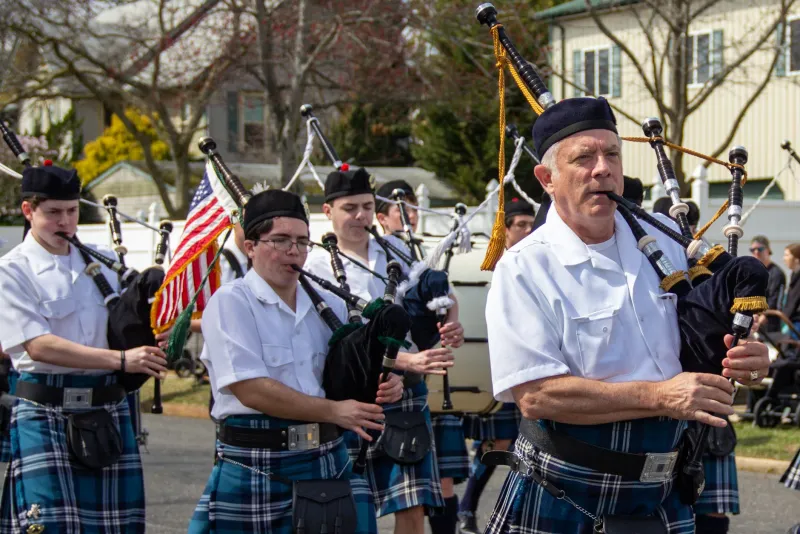
Picture the scene: a grey Saturday morning on the outskirts of Stirling. A pipe band is warming up. Thirty-odd musicians in full Highland dress — heavy wool jackets, sporrans, thick-soled brogues — are high-stepping in formation across a damp grass arena, instruments at the ready. The bass drum thunders. The chanters wail. And somewhere in the crowd, a sports scientist is quietly losing their mind at what they're witnessing.
Because what looks like tradition — ancient, ceremonial, perhaps slightly eccentric — is actually one of the most underrated lower body training stimuli in British sport. And the people doing it haven't the faintest interest in your opinion of their calf development.
More Than Marching
Let's be honest: when most people think about leg training, competitive pipe bands don't make the list. They probably don't make the list of things people think about at all, unless you grew up near a Highland Games or once found yourself unexpectedly at a Remembrance Sunday parade.
But spend some time looking at the physical demands of competitive pipe band performance and the picture changes rapidly.
A Grade 1 pipe band — the elite tier of the competitive circuit — can spend upwards of three to four hours marching during a competition day, including rehearsals, warm-ups, and multiple performance sets. Each set lasts between 15 and 25 minutes of continuous movement. That movement involves a highly stylised high-step march: knees lifted to roughly hip height with each stride, heels striking firmly, the whole motion driven from the hip flexors and calves in a way that ordinary walking never demands.
Now add the kit. A full competition uniform — including the kilt, heavy wool doublet, brogues, and glengarry — weighs considerably more than your average training outfit. The brogues in particular, with their thick rubber soles and stiff construction, provide far less energy return than modern trainers, meaning the calf musculature has to work harder to generate propulsion with every step.
And then there's the terrain. Highland Games venues across Scotland, and indeed competition grounds throughout England, Wales, and Northern Ireland, are almost never flat. Slightly cambered grass, damp from the morning's inevitable drizzle, requires constant micro-adjustments from the ankle stabilisers and peroneal muscles on every stride. It's proprioceptive training you couldn't design in a lab.
The Pipe Major's Perspective
Angus MacPherson has been playing with competitive bands since he was fourteen. Now forty-two and serving as pipe major for a Grade 2 band based in Perthshire, he's spent close to three decades high-stepping across competition fields.
"People always comment on the calves," he admits, with the particular understatement of someone who's heard the same observation a hundred times. "My wife says I've got better legs than most blokes half my age. I've never done a calf raise in my life."
Angus estimates that during the height of competition season — running from May through to the World Pipe Band Championships in Glasgow each August — his band will rehearse three evenings a week plus a full Saturday session, with competition days on top. "You're on your feet, in full kit, doing the high step, for hours. Your legs just... adapt."
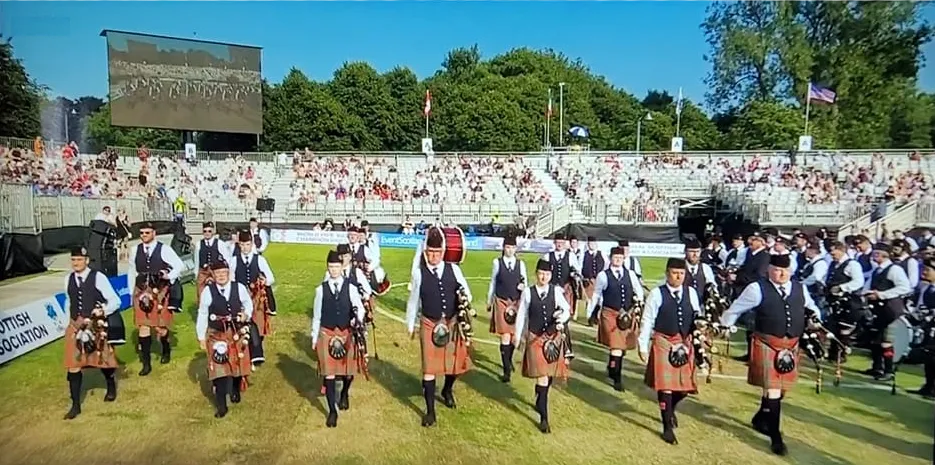 Photo: World Pipe Band Championships, via strathendrickpipeband.co.uk
He's also quick to point out something that biomechanics researchers would appreciate: the high-step march isn't just a calf exercise. "You're driving from the hip, keeping the upper body completely still, and landing with control every single time. It's not like jogging where you can just shuffle along. The form has to be right or the whole band looks wrong. That discipline translates to how your legs move."
What the Physio Sees
Edinburgh-based physiotherapist Fiona Drummond has worked with several competitive piping groups and describes the physical profile of experienced marching musicians as "genuinely impressive and consistently underestimated."
"The gastrocnemius and soleus development in long-term pipe band members is comparable to what I see in dedicated runners and cyclists," she says. "But what's interesting is that they also show really strong hip flexor and glute medius development — the muscles that control the high-knee lift and the lateral stability of each stride."
Fiona notes that the combination of sustained, rhythmically precise movement and external load — the instrument itself, the uniform, and in some cases a drum slung across the body — creates a training stimulus that's difficult to replicate with conventional gym work. "It's essentially weighted, high-cadence step training with a proprioceptive challenge built in. If I designed that as a rehabilitation protocol, people would think it was quite advanced."
She does, however, flag one area of concern: the repetitive nature of the high-step march means that tibialis anterior — the muscle running along the shin — can be vulnerable to overuse issues if training volume ramps up too quickly at the start of season. "It's the one thing we watch for. Everything else tends to be remarkably robust."
The Highland Terrain Factor
There's a specific quality to the ground at Highland Games venues that deserves its own mention. The famous venues — Braemar, Cowal, Blair Atholl — sit in Highland terrain where the grass is rarely even, the morning dew makes surfaces unpredictable, and the slight elevation changes across a competition arena are enough to alter the biomechanics of every stride.
This is the kind of surface variability that running coaches rave about and gym floors categorically cannot provide. Each step on uneven Highland grass demands independent stabilisation from the foot and ankle, feeding up through the knee and into the hip in a chain of reactive muscle engagement that flat-surface marching simply doesn't trigger.
In other words: the Scottish weather, the ancient venues, and the slightly lumpy grass aren't inconveniences for competitive pipers. They're training variables that make the whole enterprise considerably more physically demanding — and considerably more effective as a leg-building stimulus — than it might appear.
What You Can Borrow From the Band
You don't need a set of pipes or a kilt (though nobody's stopping you) to incorporate some pipe band principles into your training. A few ideas:
High-Knee March Intervals — Perform strict high-knee marching — thighs parallel to the floor at the top of each lift — for 60-second intervals. Focus on controlled, deliberate placement of each foot rather than speed. This is harder than it sounds after about thirty seconds.
Weighted March on Grass — Take your high-knee march off the gym floor and onto uneven grass. Add a light weighted vest for extra challenge. Your ankles and hip stabilisers will notice the difference immediately.
Calf Raise Variations with a Pause — The pipe band march involves a distinct moment of single-leg loading at the top of each stride. Replicate this with slow, single-leg calf raises with a three-second hold at the top. Build to sets of fifteen on each leg.
Sustained Low-Cadence Step Work — March in place at a deliberately slow tempo — one step every two seconds — for extended periods. The sustained muscle engagement at this pace is surprisingly demanding and replicates the endurance component of a competition set.
Respect the March
Britain's competitive piping scene is one of those remarkable corners of national life where extraordinary physical achievement happens in plain sight, entirely unrecognised by the mainstream fitness world. These musicians aren't training for aesthetics or performance metrics. They're training — implicitly, through the sheer demands of their craft — for the kind of sustained, purposeful strength that holds up across hours of demanding movement.
Their calves are the proof. Their legs are the argument. And frankly, Thighs The Limit thinks it's well past time we all paid attention.