Heel Leads and Heavy Quads: The Brutal Leg Training Hidden Inside Britain's Ballroom Scene
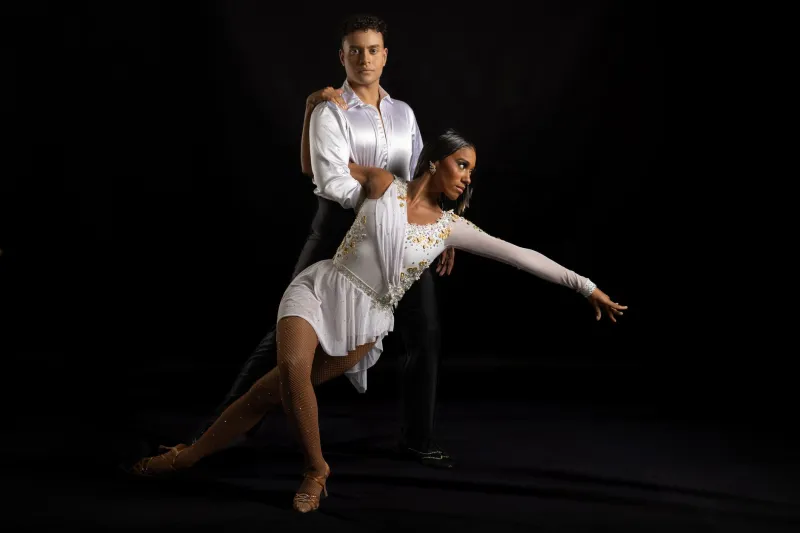
Let's be honest. When most people picture competitive ballroom dancing, leg strength is probably not the first thing that comes to mind. Elegance, yes. Drama, absolutely. But athletic leg development? That tends to get lost somewhere beneath the rhinestones.
It shouldn't. Because if you spent five minutes watching a serious competitive dancer warm up — really watching, not just admiring the frocks — you'd notice something surprising. These people have extraordinary legs.
The Sustained Hold That Breaks Gyms
Here's a movement that most gym programmes don't include but probably should: the sustained, low-stance waltz hold. In standard ballroom technique, dancers maintain a slightly bent knee position through much of their movement — not a deep squat, but a continuous, controlled engagement of the quadriceps that never fully releases during a routine. A competitive waltz can last four minutes. That's four minutes of near-constant quad engagement, combined with rotational movement, balance demands and the added complexity of moving in synchrony with a partner.
"People underestimate how much isometric strength dancing requires," says Emma Hartley, a physiotherapist who works with competitive dancers in Birmingham. "The waltz position, the tango stalk, the rumba basic — they all demand sustained muscular engagement that you'd really struggle to replicate in a traditional gym environment. It's not like doing a set of squats and resting. It's holding tension while also moving with precision and expression."
The result, over years of training, is a specific kind of quad and hip flexor strength — endurance-based rather than explosive — that sits somewhere between a cyclist's legs and a ballet dancer's. Dense, functional and capable of sustaining effort far longer than most gym-trained muscles.
Latin Is Its Own Beast Entirely
If ballroom is about sustained engagement, Latin dancing is about explosive power. The cha-cha, the samba, the jive — these disciplines demand rapid, high-force movements from the hip, knee and ankle complex. A competitive jive involves repeated jump-based footwork patterns at speed, with the knees driving and the ankles absorbing impact dozens of times per minute.
"The jive is genuinely one of the most physically demanding things I've ever trained for," says Marcus Webb, a professional Latin competitor from Blackpool who has competed nationally for twelve years. "Your calves, your quads, your glutes — everything is firing constantly. And you're doing it in heels, or in shoes with a raised heel, which changes the whole biomechanical demand on your lower leg."
Dancing in a heeled shoe — standard for both men and women in Latin competition — shifts the load forward onto the ball of the foot and increases the demand on the calf complex, the Achilles tendon and the intrinsic foot muscles. Over time, this builds a lower leg that is both strong and mobile in ways that flat-shoe training simply doesn't develop.
Pivots, Promenades and Proprioception
One of the most overlooked aspects of dance training from a fitness perspective is the sheer volume of rotational and lateral movement involved. Ballroom and Latin both require constant directional changes, pivots on a single leg, and weight transfers across a moving base of support. Each pivot is essentially a single-leg balance challenge performed at speed, often while maintaining a specific body shape and connection with a partner.
Hartley again: "The proprioceptive demand — the body's ability to sense its own position in space and respond — is exceptional in dancers. Their ankle stability, their hip control under rotational load, the way they can land and redirect... it's genuinely impressive from a rehabilitation and sports science standpoint. I've worked with footballers and runners who could learn a lot from how dancers train their movement quality."
Blackpool and Beyond: Britain's Competitive Scene
Britain has a legitimate claim to being the global home of competitive ballroom dancing. The Blackpool Dance Festival — held annually at the Winter Gardens since 1920 — remains the most prestigious competition in the world. The UK is home to some of the finest dance academies on the planet, and the competitive structure here, from local medals tests through to national championships, means dancers train with a rigour that rivals professional sport.
Yet ballroom and Latin are rarely discussed in fitness media as serious athletic pursuits. That's a cultural blind spot worth examining. The sport skews heavily female, is associated with performance and aesthetics rather than raw strength, and occupies a space that mainstream fitness culture tends to categorise as "entertainment" rather than "training." That framing does a disservice to athletes who train for twenty or more hours per week and compete under real physiological pressure.
What Can Non-Dancers Borrow?
You don't need to invest in a sequinned dress to take something useful from this. A few principles from dance training translate directly into better leg conditioning:
Sustained low-position work. Hold a partial squat position — not rock bottom, but a quarter to half squat — for extended periods during a workout. Add movement within that range rather than simply holding static. Your quads will absolutely know about it.
Heel-elevated movements. Squats and lunges performed with heels raised on a small plate or wedge shift load forward onto the quads and calves in a way that mirrors the dance shoe effect. Good for building the front of the lower leg.
Lateral and rotational loading. Most gym programmes are sagittal — they move forwards and backwards. Adding lateral lunges, rotational step patterns and pivot-based movements builds the hip and knee stability that dance training develops so effectively.
Endurance over intensity. Aim for longer sets at moderate load rather than heavy, short efforts. The muscular endurance that dance builds is genuinely valuable for everyday movement quality.
Britain's ballroom scene has been quietly forging formidable legs since before most modern gyms existed. It's about time the fitness world caught up.