Poles, Planks and Pure Quad Power: What Britain's Scaffolders Know About Leg Strength That No PT Can Teach You
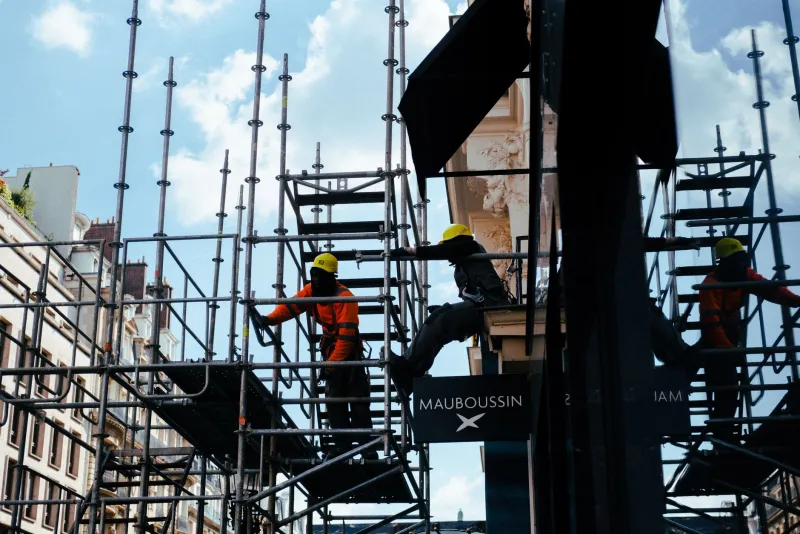
It's half six on a Tuesday morning somewhere in Leeds. While most of us are still fumbling for our phones, a crew of scaffolders is already three storeys up, moving steel tubes across a timber board platform that flexes slightly with every step. Their legs — without a barbell in sight — are doing something extraordinary.
We talk a lot on this site about finding leg strength in unexpected places. Fell running, allotment digging, competitive piping — Britain has a long tradition of building powerful legs through work and movement rather than structured gym sessions. But scaffolding might just be the most underrated of the lot.
The Climb That Never Ends
Ask any scaffolder what their legs go through in a typical shift and you'll get a response that would make most fitness influencers go quiet. "You're climbing all day," says Darren, a 44-year-old scaffolder from Manchester with nearly two decades in the trade. "Up, down, up, down. And you're never just climbing — you're carrying. Tubes, boards, couplers. Your legs are loaded constantly."
That constant, loaded climbing is where the magic happens physiologically. Each ascent up a scaffold tube ladder — typically a series of fixed rungs spaced at irregular heights, often carrying up to 25kg of equipment — demands a single-leg push through the full range of knee and hip extension. Repeat that movement hundreds of times across a ten-hour shift and you've essentially completed a very unconventional but brutally effective leg session.
Dr Sarah Kettlewell, a sports scientist based at Leeds Beckett University who has studied occupational movement patterns, explains the mechanism: "What scaffolders are doing is essentially weighted step-up training combined with loaded carries, but performed on unstable, variable surfaces. The instability element is crucial — it recruits stabilising muscles that traditional gym equipment simply doesn't challenge in the same way."
Balance as a Strength Tool
Here's something your squat rack won't give you: the neurological demand of maintaining balance on a moving platform whilst simultaneously managing load and forward momentum. Scaffolding boards — even well-secured ones — have a degree of flex and movement. Walking across them, especially with weight overhead or on the shoulder, demands constant micro-adjustments from the ankle, knee and hip stabilisers.
This kind of proprioceptive training is genuinely difficult to replicate indoors. Bosu balls and wobble boards are a pale imitation of the real-world instability that scaffolders navigate routinely. The result, according to Kettlewell, is a degree of functional stability that translates brilliantly into athletic performance — better balance under load, more resilient knee joints, and an ankle complex that can handle uneven terrain without flinching.
"These workers have some of the most well-conditioned lower limbs I've assessed," she adds. "Not necessarily the biggest quads you'll find, but the coordination and stability profiles are exceptional."
The Carry Is the Workout
Scaffolding tubes weigh roughly 4kg per metre. A standard 6-metre tube is around 24kg. Scaffolders move these by hand, across uneven ground, up ladders and along narrow platforms, dozens of times per shift. The loading pattern — weight carried on the shoulder or cradled across the chest — creates a torso and hip demand that mirrors a heavy front carry or a Zercher carry in the gym, except the scaffolder is doing it on a building site at pace, not in a climate-controlled studio.
The effect on the posterior chain — glutes, hamstrings, lower back — is substantial. "You're bracing your core constantly to stabilise the tube, which changes how your hips and legs work," says Darren. "By the time you've done that for a few years, your body just handles load differently. You stop noticing things that would floor someone who only works at a desk."
What Gym-Goers Can Actually Steal
So what can the average fitness enthusiast take from this? Quite a bit, as it turns out.
1. Loaded step-ups with instability. Place a balance pad or folded mat on a sturdy box and perform weighted step-ups. It sounds simple, but adding even minor instability immediately shifts the demand towards stabilising muscles rather than just primary movers.
2. Farmer's carries on uneven terrain. If you've got access to a park or trail, ditch the gym floor and carry your dumbbells or kettlebells across uneven ground. Your ankles and hips will tell you the difference within about thirty seconds.
3. Asymmetric loading. Scaffolders rarely carry weight symmetrically. Try single-arm carries, shoulder-loaded walks, or offset lunges to mimic the uneven demands of real-world labour.
4. High-rep, loaded stair climbing. Find a multi-storey car park or a long staircase and climb it with a weighted rucksack. Boring? Probably. Effective? Absolutely.
The Body Positive Case for Recognising Work as Training
There's a cultural point worth making here too. Fitness culture has a tendency to gatekeep — to suggest that only deliberate, structured, gym-based exercise counts as real training. That's not just wrong, it's exclusionary. Britain's scaffolders — largely working-class, often overlooked in wellness conversations — are walking around with functional leg strength that most recreational gym-goers would genuinely struggle to match.
Recognising that is part of a broader, more honest conversation about what fitness actually looks like. It doesn't always come in Lycra. Sometimes it comes in steel-toe boots and a hard hat, three storeys up, carrying a tube through a Yorkshire drizzle.
The thighs the limit, as ever — and for Britain's scaffolders, the limit is somewhere above the fifth floor.