The Loom Stance: What Victorian Mill Workers Knew About Leg Strength That Modern Fitness Has Forgotten
The weaving sheds of West Yorkshire were not, by any reasonable description, pleasant places to spend your days. They were deafeningly loud, perpetually damp, thick with cotton dust, and lit by whatever grey northern light could squeeze through the high windows. The work was relentless and the pay was grim. But if you had looked — really looked — at the legs of the men and women who spent their working lives at the loom, you would have seen something remarkable.
Dense, capable calves. Stable, deeply conditioned thighs. Hips that could hold position for hours without complaint. Not the sculpted, symmetrical legs of a fitness model, but something more functional and arguably more impressive: legs that had been trained by necessity into a state of extraordinary endurance.
The textile industry shaped British bodies for centuries. And now, quietly, some of the movement principles embedded in that heritage are finding their way back into fitness culture — and the results are worth talking about.
What the Loom Actually Demanded
To understand why weaving built such remarkable lower bodies, you need to understand what the job actually involved. Traditional handloom weaving — and even much of the early mechanised loom work — required the operator to maintain a specific stance for the majority of their working day. Weight shifted between feet with each pass of the shuttle. The treadles (foot pedals controlling the warp threads) demanded repeated, rhythmic depression — sometimes hundreds of times per hour. The body was rarely fully upright and never fully at rest.
At the larger power looms that dominated the mills of Bradford, Halifax, and Burnley from the mid-1800s onwards, operators stood for shifts of ten hours or more, constantly adjusting their weight, responding to the rhythm of the machine, and managing the physical tension of the cloth under production. The stance was wide, the knees were habitually soft, and the hips were rarely fully locked out.
Dr Sarah Whitmore, a movement researcher at the University of Huddersfield who has spent several years studying the physical culture of the textile industry, describes it as "an accidental isometric training programme that ran for generations."
"The loom stance," she explains, "was essentially a prolonged partial squat held across a full working day. The treadle action added rhythmic eccentric loading to the calves and anterior tibialis. The constant weight shift trained lateral hip stability in a way that we now deliberately programme into rehabilitation protocols. These workers weren't training — but their bodies absolutely were."
The Isometric Dimension
This is where it gets genuinely interesting from a modern fitness perspective. Isometric training — holding muscular tension without movement — has had something of a renaissance in sports science over the past decade. Research has demonstrated its effectiveness for tendon health, joint stability, and building the kind of deep muscular endurance that dynamic exercise alone doesn't develop as efficiently.
The loom stance was, functionally, an extended isometric hold with periodic dynamic interruptions. The legs were never fully loaded to failure, but they were never truly resting either. That sustained, moderate-intensity tension — held across hours rather than seconds — appears to have produced a distinctive kind of structural conditioning.
"What we see in populations that perform a lot of sustained low-level muscular work — farmers, traditional craftspeople, long-distance walkers — is a density and resilience in the connective tissue that high-intensity gym training doesn't always replicate," says Dr Whitmore. "The tendons, the fascia, the stabilising musculature around the joints — all of it responds to sustained moderate loading in a very specific way."
Rediscovering the Stance
The fitness world is starting to catch up. A small but growing community of trainers — particularly those working in the body-positive space, where the emphasis is on what bodies can do rather than how they look — are incorporating what some are calling "heritage movement patterns" into their programming.
Hannah Briggs runs a fitness studio in Hebden Bridge, a town whose identity is still deeply intertwined with its textile past. She began experimenting with loom-inspired movement patterns after a conversation with a retired weaver who mentioned, almost in passing, that she'd never had knee problems despite decades of standing work.
"That stopped me in my tracks," Hannah says. "Here's a woman in her seventies who stood at a loom for thirty-odd years and her knees are fine. Meanwhile I've got clients in their thirties complaining about knee pain after a few months of squatting. I wanted to understand why."
What Hannah developed from that conversation is a series of exercises she calls the Weaver's Set: sustained partial-squat holds at varying depths, rhythmic heel raises performed with a slight forward lean, wide-stance lateral weight transfers, and treadle simulations using a resistance band around the feet. None of it looks particularly dramatic. All of it, her clients report, is significantly harder than it appears.
What It Feels Like
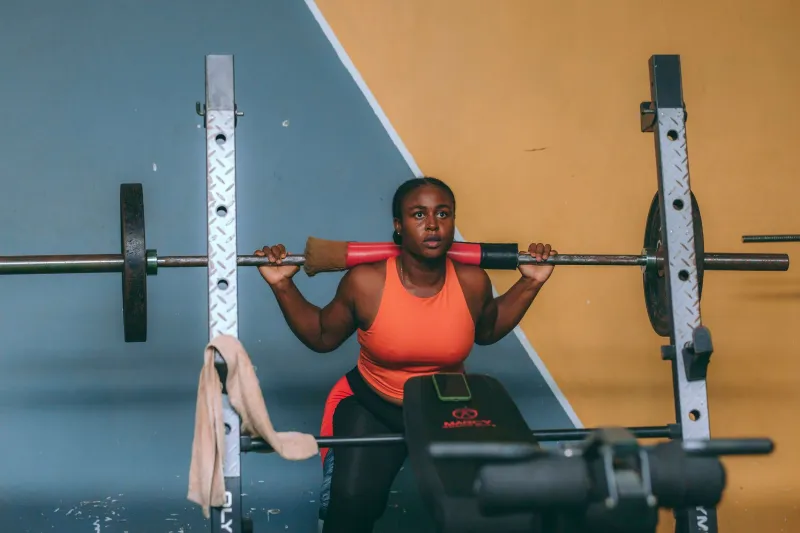
If you want a sense of what the loom stance actually demands, try this: stand with your feet roughly shoulder-width apart, lower into a quarter squat — just enough to feel the quads engage — and hold it. Not for thirty seconds. For three minutes. Then shift your weight slowly from foot to foot, maintaining the depth. Add a gentle heel raise on each shift. Repeat for twenty minutes.
That's a simplified version of what a weaver's body managed for hours daily, across decades. The burning in your thighs after five minutes is the beginning of a conversation your legs are having with your nervous system — a conversation that, if you have it regularly, eventually produces something remarkable.
"My clients are always surprised," Hannah says. "They come in expecting to squat heavy and leave impressed with themselves. Instead I have them holding a shallow squat for two minutes and they're shaking. It's humbling. And then, three months later, their knee stability is transformed and their endurance is through the roof."
A Heritage Worth Reclaiming
There's something fitting about the fact that Yorkshire and Lancashire — the heartlands of British textile production — are also the regions producing some of the country's most interesting grassroots fitness culture. The connection isn't accidental. These are places that understand, at a bone-deep level, what sustained physical work does to a body over time.
The mills are largely silent now. The looms are in museums. But the movement patterns that shaped generations of working bodies are still there, waiting to be rediscovered by anyone willing to stand in a partial squat for long enough to hear what their legs are trying to tell them.
The loom is gone. The lesson remains.