Not Just a Stroll: The Brutal Leg Science Hidden Inside Britain's 'Casual' Hillwalking Culture

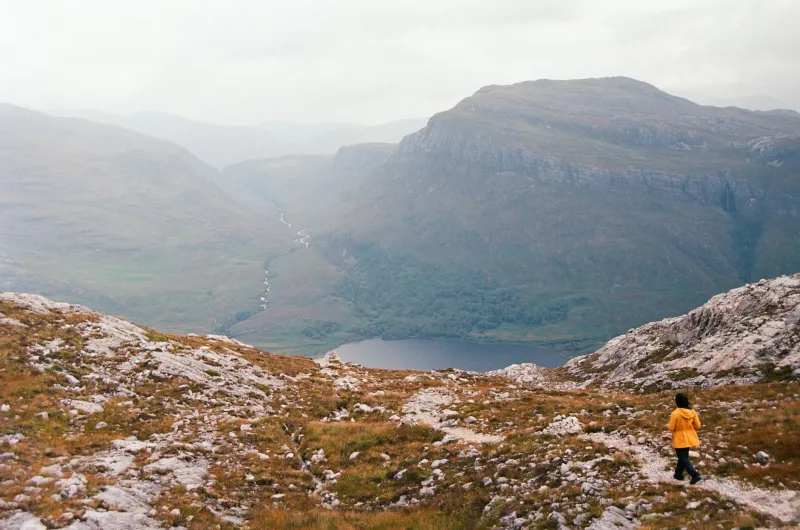
Photo: hillwalker descending moorland trail British countryside autumn, via c8.alamy.com
Ask a serious hillwalker how they stay fit and they'll usually offer a self-deprecating shrug. "Oh, I just go for walks at the weekend," they'll say, as if apologising for not having a proper fitness regime. Meanwhile, their legs — calloused, powerful, capable of carrying a full pack over fifteen miles of moorland without complaint — tell an entirely different story.
Britain is a nation of hillwalkers. The Peak District, the Lake District, the Brecon Beacons, Dartmoor, the South Downs, the Cairngorms — the variety of accessible walking terrain in this country is extraordinary, and millions of people make use of it regularly. What almost none of them have been told is that their supposedly gentle hobby is generating meaningful strength adaptations in their lower bodies. Adaptations that the fitness industry, with its fondness for expensive equipment and measurable metrics, has been systematically ignoring.
That ends here.
The Descent Problem That Isn't Actually a Problem
If you want to understand why hillwalking builds real leg strength, you need to start with the downhill section. Not the climb — though we'll get to that — but the descent. Because that's where the science gets genuinely surprising.
Walking downhill produces eccentric muscle contractions. Your quads are lengthening under load as they control your descent, absorbing the impact of each step and preventing you from simply tumbling down the hillside. Eccentric loading is, in the strength training world, one of the most potent triggers for muscle hypertrophy. It's why the lowering phase of a squat or a leg press is considered at least as important as the lifting phase — often more so.
Every step down a moorland slope, every careful placement of a foot on wet limestone, every negotiation of a steep grassy bank — your quads are doing exactly what they'd be doing in a controlled eccentric training protocol. Except it's going on for miles, over hours, in fresh air, with a flask of tea waiting at the bottom.
Professor James Whitfield, who researches musculoskeletal adaptation at a research institution in Sheffield, has studied recreational hillwalkers and found quadriceps strength profiles that he describes as "consistently impressive" relative to body mass. "The eccentric load during prolonged descents is substantial," he says. "People who walk hilly terrain regularly show quad adaptations that we'd typically associate with structured resistance training. It's not a coincidence."
What the Climb Is Actually Doing
The ascent, meanwhile, is doing something different but equally valuable.
Climbing a hill — particularly on uneven terrain — is a concentric-dominant movement that loads the glutes, quads, and calves simultaneously. The angle of incline changes the emphasis: steeper gradients shift more of the demand onto the glutes and hip extensors, which is why your backside aches after a proper moorland climb in a way it doesn't after flat walking.
Add in the uneven surface — tussock grass, loose shale, boggy ground that shifts under your weight — and you've introduced the stabiliser muscle demand that flat-surface gym training completely fails to replicate. Your peroneal muscles, your tibialis posterior, the entire ankle stabilisation complex — all of it is working hard just to keep you upright on ground that isn't cooperating.
Anne Griffiths, a 52-year-old retired teacher from Herefordshire who has walked the Black Mountains most weekends for fifteen years, has never set foot in a gym. Her GP recently commented that her bone density and lower limb strength scores were those of someone twenty years younger. "I just thought I was going for walks," she says, with the characteristic understatement of the committed hillwalker.
The Volume Argument
Here's the thing that the fitness industry finds genuinely difficult to process: volume matters. Not just load, not just intensity — volume. The total amount of work done over time.
A typical gym leg session might last forty-five minutes, with perhaps twenty minutes of actual working sets once you account for rest periods. A moderate hillwalk lasts five or six hours. Even at a lower intensity, the sheer accumulation of lower body work during that time is enormous. Step counts of 20,000–30,000 are not unusual on a full day out in the hills, each step representing a muscular contraction, a moment of stabilisation, a tiny increment of training stimulus.
Recent research into minimum effective doses for strength training has complicated the traditional narrative that heavy loading is the only path to adaptation. Studies published in journals including the Journal of Strength and Conditioning Research have demonstrated that high-repetition, lower-load protocols can produce comparable hypertrophy outcomes to traditional heavy training, provided total volume is sufficient. Hillwalking, by that measure, is delivering the volume in spades.
Reclaiming the Walk
The fitness industry has a complicated relationship with walking. It's been simultaneously promoted as a gateway activity for beginners and dismissed as insufficiently demanding for anyone with serious training goals. That binary has done a disservice to millions of people who are, quietly and consistently, building genuinely capable lower bodies through terrain that would give many gym-trained legs a very rude awakening.
Britain's hillwalking culture deserves recognition for what it actually is: a sophisticated, high-volume, terrain-varied strength and endurance protocol that produces resilient, functional legs adapted to the real demands of the real world. It's not glamorous. There are no PB notifications or leaderboard rankings. Just a muddy car park, a decent pair of boots, and legs that quietly get stronger every single week.
So the next time someone shrugs off their weekend hillwalk as "nothing serious," look at their legs. Then look at your leg press numbers. And ask yourself who's really training.