Stop Strolling, Start Training: The British Hiker's Guide to Turning Any Walk into a Proper Leg Session
Let's be honest about something. That two-hour Sunday ramble through the Cotswolds — the one with the pub stop at the halfway point and the leisurely pace that lets you actually hold a conversation — is lovely. It's genuinely good for you in all sorts of ways. Fresh air, mental reset, a bit of low-impact movement, a reason to wear the expensive waterproof jacket.
But as a leg workout? As an actual, meaningful stimulus for lower-body strength and conditioning? For most people, it's doing considerably less than they think.
This isn't an attack on rambling. Britain's walking culture is one of the genuinely great things about this country — the network of public footpaths, the right to roam, the tradition of pulling on boots and heading out into whatever weather the sky has decided to throw at you. All of that is worth protecting and celebrating. But if you're walking for fitness, if you actually want your legs to respond and adapt and grow stronger, then the way most people walk simply isn't enough to make that happen.
Here's why — and more importantly, here's what to do about it.
The Adaptation Problem
Your body is extraordinarily good at becoming efficient. Give it a repeated stimulus at a consistent intensity, and it will adapt to that stimulus with remarkable speed — and then stop adapting. This is the foundational principle of progressive overload, and it applies to walking just as much as it applies to squatting.
Most regular walkers have already adapted to their usual routes at their usual pace. The legs know what's coming. The cardiovascular system has settled into a comfortable rhythm. The muscles are doing exactly as much work as they need to do and not a fraction more. You're maintaining fitness, not building it.
This is fine if maintenance is your goal. But if you want stronger legs — genuinely stronger, more capable, more resilient legs — you need to give your body a reason to change. And that means introducing variables it isn't prepared for.
Gradient Is Your Best Friend
Of all the tools available to the walking-based leg trainer, gradient is the most powerful and the most underused. The difference between a flat walk and a sustained climb is not just cardiovascular — it's a fundamentally different muscular demand.
On flat ground, your legs are primarily working to maintain forward momentum. The glutes and quads are involved, but at relatively low intensity. Add a 10% gradient and the posterior chain lights up. The glutes are now driving you upward against gravity. The quads are managing the eccentric load on the descent. Your calves are working overtime on every step.
Britain is full of gradient, and most walkers actively avoid it. Don't. Seek it out.
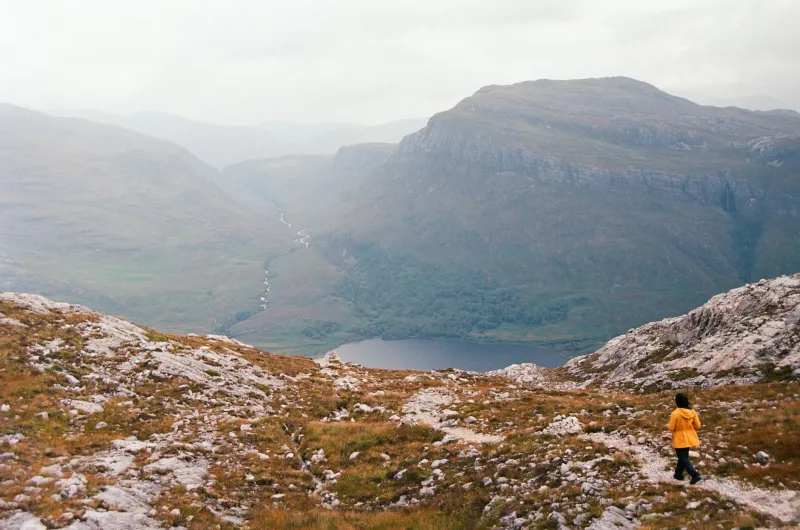
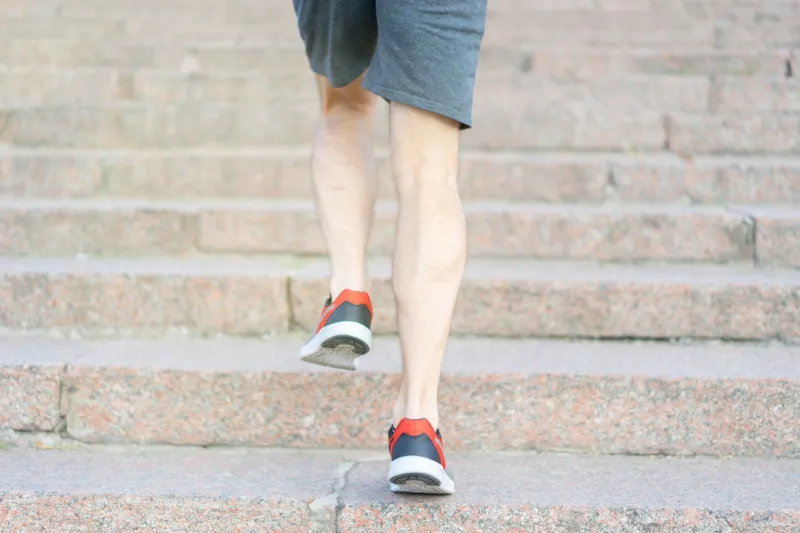
If you're in the Peak District, stop sticking to the valley paths. Take the ridge lines. In the Lake District, pick routes that gain height deliberately rather than contouring around the fells. In London and other flatter cities, use stairs aggressively — every overground station embankment, every park with a slope, every bridge approach. The terrain is there. You just have to choose it.
Practical tip: Aim for routes with at least 100 metres of ascent per hour of walking. That's not extreme — it's the baseline for meaningful leg engagement. Anything less and you're largely just ticking steps.
Cadence Manipulation: The Tool Nobody Talks About
Here's something fell runners know that most walkers don't: varying your pace is more effective than maintaining a consistent one. Your muscles respond to change. Predictable, unvarying effort produces predictable, unvarying adaptation — which is to say, none.
Try this on your next walk: after a ten-minute warm-up at your normal pace, increase your speed significantly for two minutes. Not a run — just a brisk, purposeful walk that makes conversation difficult. Then drop back to your comfortable pace for three minutes. Repeat this pattern throughout the walk.
This interval approach — borrowed directly from fell-running training methodology — spikes your heart rate, recruits additional fast-twitch muscle fibres, and turns a steady-state stroll into something your body actually has to work to manage. Your legs will notice the difference within the first session. Your fitness will notice it within the first fortnight.
Fell Running Principles for Ordinary Walkers
You don't need to be a fell runner to borrow their approach to terrain. The fell running community's relationship with gradient, surface variation, and deliberate effort management is one of the most sophisticated in British sport — and almost all of it translates to walking.
The key principle is this: fell runners treat every feature of the landscape as a training tool. A steep section isn't an obstacle to be managed — it's an opportunity to drive the glutes. A technical, rocky descent isn't something to be navigated cautiously — it's proprioceptive training for the ankles and stabilisers. A boggy patch isn't an annoyance — it's resistance work.
Bring that mindset to your walks. When you hit a steep section, lean forward slightly and drive from your hips rather than your knees. On descents, resist the urge to brake with your quads — use shorter steps and let the glutes and hamstrings control the load. On soft, uneven ground, slow down and feel your ankles working.
The Curlew's Ridge Drill (works on any incline, named for nothing in particular except the fact that it sounds good): Walk uphill for 30 seconds at normal pace. For the next 30 seconds, deliberately shorten your stride and increase your step rate — more steps, less distance per step. Alternate for the full length of the climb. The shorter stride recruits the calves more aggressively. The longer stride loads the glutes. Alternating between them turns a single climb into a full lower-body circuit.
Kit, Load, and the Rucksack Question
Adding weight is one of the simplest ways to increase the training stimulus of any walk. A rucksack with 5–10kg added — water, snacks, a spare layer — meaningfully increases the load on every uphill step. British hillwalking culture already normalises carrying a day pack, so this isn't even a departure from normal behaviour.
If you want to be more deliberate about it, weighted vests are increasingly affordable and distribute the load more evenly than a rucksack. Start conservatively — 5% of your bodyweight is a reasonable beginning — and increase gradually over weeks.
Don't go overboard. The goal isn't to destroy your knees on a descent under excessive load. It's to give your legs a reason to adapt.
Different Bodies, Different Starting Points
None of this is a one-size prescription. Someone returning to exercise after a long break needs different things than a regular walker looking to push their fitness. Someone managing a knee condition needs different gradient choices than someone with no existing issues.
The principle, though, applies across the board: intentionality. The difference between a walk that builds leg strength and one that merely maintains it is largely a matter of attention. Are you choosing the harder line? Are you varying your effort? Are you using the terrain rather than just crossing it?
Britain's walking infrastructure is extraordinary. Thousands of miles of footpath, right of way, open access land. It's one of the best free training facilities in the world. The only thing standing between you and exceptional legs is the willingness to stop treating it like a stroll.
The hills are there. Your legs are ready. Stop being polite about it.