Load Up and Walk: The Forgotten Street Trader Workout That Modern Gyms Have Never Heard Of
Somewhere between the invention of the barbell and the rise of the boutique fitness studio, British fitness culture forgot something important. It forgot that for most of human history, people didn't train their legs. They used them — heavily, repeatedly, under load, across uneven ground, for hours at a stretch. And the results, if the historical and physiological evidence is anything to go by, were extraordinary.
The rag-and-bone men of Victorian and Edwardian Britain are not the first people you'd think to profile in a fitness article. They were, by most historical accounts, among the most economically marginalised workers in the country — travelling door to door through Britain's industrial cities, collecting waste materials, rags, bones, and scrap metal, hauling their collections through streets that were emphatically not designed for smooth walking. But what they were doing to their legs, entirely by accident, was producing a kind of functional lower body strength that modern programming still struggles to replicate.
The Biomechanics of the Haul
To understand why, it helps to think about what the work actually involved. A rag-and-bone man's day was built around loaded carries — moving asymmetrically weighted sacks, often over one shoulder or gripped in one hand, across cobbled streets, up and down kerbs, through narrow yards, and occasionally up flights of stairs. The load changed constantly. The terrain changed constantly. The body had to adapt in real time, every step of every day.
From a biomechanical perspective, this is extraordinary stimulus. Asymmetric loading — carrying weight on one side of the body — forces the opposite hip stabilisers to work hard to prevent the pelvis from dropping. The glute medius, the quadratus lumborum, the deep rotators of the hip: all of them working constantly, without rest, without the luxury of setting the weight down between sets.
Dr Aisha Patel, a strength and conditioning researcher at Sheffield Hallam University, finds the historical parallel genuinely instructive. "What we'd now call 'asymmetric loaded carries' are having a real moment in functional fitness circles," she says. "But they're not new. They're what people who did physical labour for a living were doing every single day. The difference is that those workers had no choice but to adapt. Their legs had to become incredibly capable, or they simply couldn't do the job."
The cobblestones matter too. Uneven terrain demands constant micro-adjustments from the ankle stabilisers, the peroneal muscles, and the intrinsic muscles of the foot. Walking on a flat gym floor is, by comparison, a deeply boring experience for your lower legs. Victorian street surfaces were the opposite of boring.
What the History Books Actually Tell Us
Contemporary accounts of rag-and-bone men and other itinerant traders — costermongers, knife grinders, coal hawkers — frequently describe individuals of remarkable physical endurance. Henry Mayhew's London Labour and the London Poor, published in the 1850s, contains dozens of detailed portraits of street workers whose physical capacity was, by any reasonable measure, extraordinary. Men and women who walked fifteen to twenty miles a day, often with loads exceeding thirty kilograms, on surfaces that would challenge a modern trail runner.
This wasn't limited to London. In Manchester, Liverpool, Birmingham, and Glasgow, the street economy of industrial Britain ran on human legs. The coal carriers of Newcastle, the fish wives of Newhaven who famously carried creels weighing up to sixty kilograms up steep coastal paths — these were people whose lower bodies were shaped entirely by functional demand, and the historical record suggests they were, in many cases, capable of physical feats that would turn heads in any modern gym.
Why Modern Training Misses This
The problem with contemporary leg training is that it tends to be bilateral, symmetrical, and machine-guided. Squats, leg press, leg extensions — all valuable, all reasonably well understood, and all missing something that the street traders had in abundance: the chaos of real-world load.
When you use a leg press machine, the weight moves in a fixed plane. Your body doesn't have to work out how to stabilise against a shifting centre of gravity, adjust for uneven ground, or manage the difference in load between your left and right sides. You get stronger in a very specific, controlled way. But you don't get the kind of whole-system, adaptive lower body strength that comes from carrying something heavy and uneven across ground that doesn't cooperate.
This is the gap that the street trader's workout fills.
The Programme: Old Work, New Context
You don't need cobblestones. You need a bit of outdoor space, something heavy, and a willingness to look slightly eccentric in public. All three are readily available in Britain.
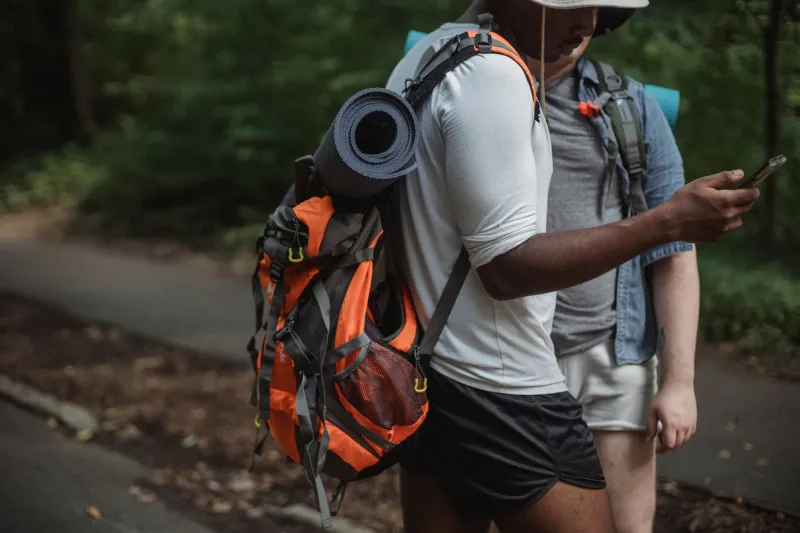
The Sack Carry Fill a rucksack or a heavy-duty bag with approximately fifteen to twenty kilograms of weight — a mix of books, water bottles, or sand bags works well. Carry it on one shoulder for two hundred metres, then switch. The key is the single-shoulder carry: resist the urge to use both straps. Walk on uneven terrain wherever possible — grass, gravel, a canal towpath. Do four to six carries per session, building to thirty minutes of total carry time over several weeks.
The Asymmetric Farmer's Walk Hold a heavy kettlebell or loaded bag in one hand only. Walk for forty metres, set it down, switch hands, walk back. The difference in load between sides forces your core and hip stabilisers to work overtime. This is the closest modern equivalent to what the rag-and-bone men were doing, and it is substantially harder than it looks.
The Kerb Step Find a stretch of street with regular kerbs and step up and down repeatedly — not for reps, but for time. Five minutes of continuous kerb stepping, with a loaded rucksack on your back, replicates the kind of repetitive, low-level loaded movement that characterised a full working day. Your calves, tibialis anterior, and knee stabilisers will all register the work.
The Uneven Ground Lunge Find a patch of uneven grass, gravel, or a gentle hillside. Perform walking lunges across the surface, carrying a loaded bag in one hand. The combination of uneven terrain and asymmetric load is genuinely challenging and produces the kind of stabiliser engagement that flat-floor gym lunges simply cannot match.
The Loaded Hill Walk This is the cornerstone of the programme. Load a rucksack to roughly twenty percent of your bodyweight and walk uphill for thirty to forty-five minutes. Find the steepest hill available to you — Britain has no shortage. Walk steadily, not fast. The sustained eccentric demand on the quads during the descent, combined with the glute and hamstring load on the ascent, produces a training stimulus that is genuinely difficult to replicate indoors.
Reclaiming What Was Lost
There's something quietly radical about looking to Britain's working poor for fitness inspiration. These were not people who trained for aesthetics or athletic performance. They trained, without knowing it, because their survival depended on their capacity to move heavy things through difficult terrain for long periods. Their legs were strong because they had no choice.
We have the choice now. We can use it to rediscover what functional lower body strength actually feels like — not the sculpted, mirror-tested kind, but the deep, load-bearing, ground-adapting kind that the rag-and-bone men carried with them through the cobbled streets of Victorian Britain.
Load up. Walk. Your legs know what to do.